
Updated: 12/12/2025
Livestock Theft Arrest Shines a Light on the Dark Side of Horse Theft and the International Slaughter Pipeline.
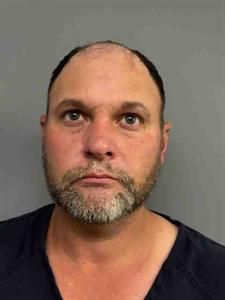
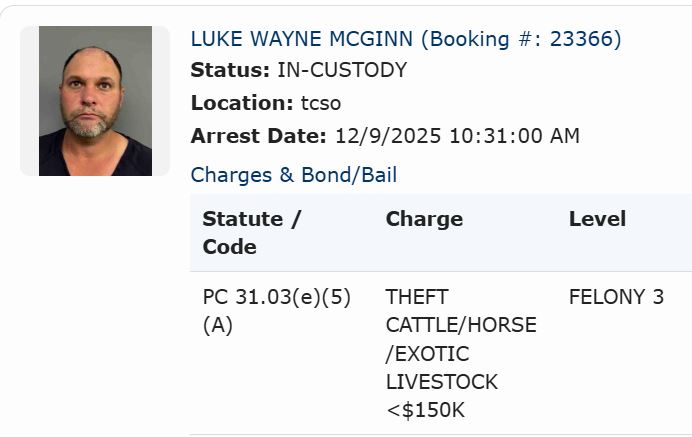
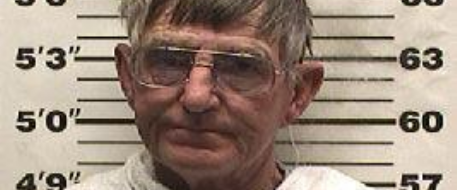
TRINITY COUNTY, Texas — A Grapeland man, Luke Wayne McGinn, was arrested Tuesday afternoon by the Trinity County Sheriff’s Office for allegedly attempting to steal multiple livestock. It is unclear if the livestock were cattle, horses, or both. The arrest has highlighted Texas's stringent laws regarding livestock theft and the potential connection of such crimes to the international horse slaughter pipeline.
McGinn faces serious charges, including theft of cattle/horse/exotic livestock and cruelty to livestock. The Trinity County Sheriff's Office deserves commendation for its response and arrest; such diligent law enforcement efforts are vital for disrupting criminal networks, protecting agricultural assets, and bringing perpetrators to justice.
"Stolen Horse International commends the Trinity County Sheriff’s Office for their decisive action in capturing and arresting this alleged livestock thief," said Debi Metcalfe, Founder of Stolen Horse International (NetPosse.com). "Diligent efforts by law enforcement agencies in Texas are absolutely vital in disrupting these criminal enterprises that exploit livestock and victimize owners. We are incredibly grateful for their work to bring justice to victims and protect our state's valuable livestock."
The Allegations
It appears this is not the first time McGinn has faced these accusations. The Grapeland resident was previously arrested on May 6, 2023, by the Trinity County Sheriff’s Office in connection with allegedly attempting to steal horses, according to one online article. The recent arrest on December 9th, 2025, may stem from a probation violation related to the 2023 charges.
McGinn and an unnamed juvenile were taken into custody around 2:45 p.m. after deputies responded to the area of 3571 Farm to Market Road 2262. Authorities seized a truck towing a large green trailer containing multiple horses at the scene.
News articles and social media posts from sources like the East Texas Daily indicate that the December arrest was for a new Felony 3 livestock-theft charge. However, comments from family and friends on social media suggest that the latest arrest is related to a probation violation stemming from the 2023 charges, noting that when probation is violated, the original charge is often listed.
Texas Takes Livestock Theft Seriously
In Texas, livestock theft is automatically treated as a serious offense. McGinn is currently in custody on a third-degree felony livestock-theft charge, a statute covering the theft of cattle, horses, or exotic livestock valued under $150,000. Again, it is unclear whether his arrest is related to the 2023 charge and a probation violation.
Ranchers and lawmakers do not take these crimes lightly. A third-degree felony for livestock theft carries significant penalties, including 2 to 10 years in prison and a potential fine of up to $10,000. This tough stance is intended to protect the state's valuable agricultural industry, where large numbers of animals can be easily moved and sold.
The "Slaughter Pipeline" Connection to Livestock Theft
The arrest of Luke Wayne McGinn on felony livestock-theft charges has drawn significant attention to the complex issue of agricultural crime and the pathways by which stolen animals may enter the food supply chain; however, it is essential to clarify that McGinn has not been accused of sending any stolen livestock into the slaughter pipeline.
Nevertheless, the high-profile nature of this case offers a critical opportunity to educate the public about the severe risks and potential outcomes for horses and other livestock once they are removed from their owners' care.
Animal welfare advocates often link incidents of livestock theft to the "slaughter pipeline." While the slaughter of horses for human consumption was banned on U.S. soil in 2007, tens of thousands of American horses are still shipped to processing plants in Mexico and Canada annually.
To disguise stolen horses and hinder identification at auctions, thieves primarily rely on a combination of physical alteration techniques—such as dyeing or using mud to obscure white markings on the coat, face, and legs—and "paper laundering" scams involving fraudulent documentation.
This system creates a dark network where stolen horses can be quickly sold to "kill buyers" at auctions. The horses are often transported long distances in crowded conditions and processed so quickly in foreign facilities that it is extremely difficult for owners to trace and recover their animals.
Investigations have revealed that this network can also be leveraged and provide cover for other criminal activities, including drug trafficking, money laundering, and human trafficking.
Associated Crimes - Criminal Exploitation of the Slaughter Trade
The high-volume, unregulated cash flow generated by the horse slaughter industry creates an ideal environment for organized crime. Investigations have revealed that the network and infrastructure used for moving horses are leveraged for more serious criminal activities:
- Drug Trafficking: The trailers and routes used to transport horses across international borders are also used for moving illegal drugs. There are reports of criminals using the horses themselves to conceal and traffic narcotics.
- Money Laundering: The sale of horses—sometimes involving inflated prices or fraudulent "bailout" schemes that prey on public emotion—creates an unregulated flow of cash that can be used to launder money from other illicit activities.
- Human Trafficking: The same network and routes of transport have been linked to human smuggling and sex trafficking operations.
- Extortion: Criminals sometimes run schemes where they demand "bail" money by a strict deadline to "save" a horse they threaten to send to slaughter, effectively extorting money from concerned individuals and rescues.
Advocates like Stolen Horse International (NetPosse) emphasize that shutting down the horse slaughter pipeline is a crucial step not only for animal welfare but also for dismantling a dangerous network of organized crime.
Stolen Horse International: 28 Years of Bringing Horses Home
Navigating the aftermath of a theft requires specialized support. Stolen Horse International (NetPosse) has been actively working with victims of horse theft for over 28 years since 1997, providing crucial resources, support networks, and educational materials to help owners recover their animals and prevent future crimes.
The 501(c)(3) nonprofit organization operates a widely recognized database and alert system, which serves as a vital tool for owners and law enforcement in tracking missing horses and raising public awareness. Visit the organization's leading social media outlet on Facebook, Stolen Horse International-NetPosse Missing and Stolen Equine, to view more lost, found, missing, and stolen horses across the United States.
Recent Texas Incidents Highlight Ongoing Risk
- Two colt draft horses reported missing in Smith County in January 2024 were later found and returned home.
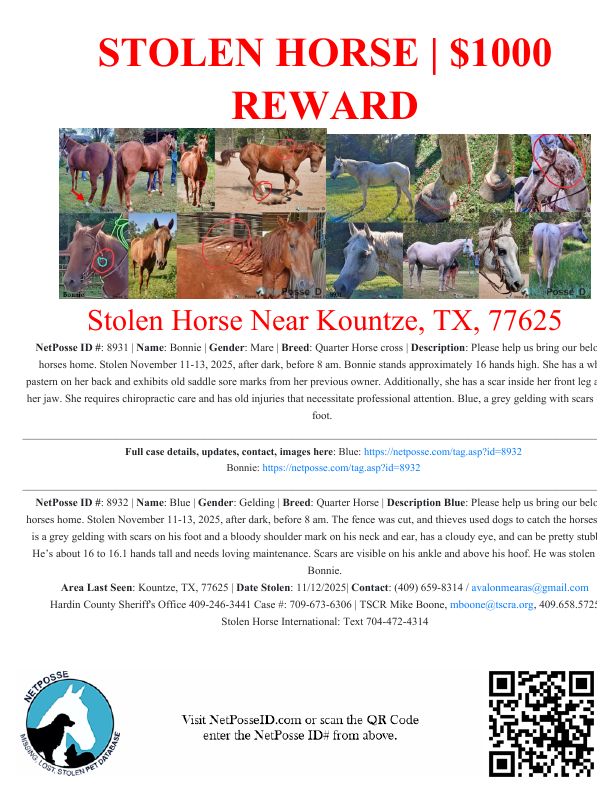
- A family in Hardin County, Texas, reported the theft of two horses, "Bonnie" and "Blue", from their pasture overnight on November 13-14, 2025. A large-scale search is underway, with the family offering a reward for their return.
Stolen Horse International continues to circulate information about recent cases across East Texas, including Bonnie and Blue's case, which has been widely shared by the organization, which also operates under the names NetPosse.com or NetPosse.org.
- Website Listing: Both horses are listed as active cases on the Stolen Horse International website..
- Blue's case details can be found on his dedicated webpage. (https://netposse.com/tag.asp?id=8932)
- Bonnie's case details can be found on her dedicated webpage. (https://netposse.com/tag.asp?id=8931)
- Details: The horses were stolen from their pasture at 15928 FM 943 in Kountze, TX, between November 12 and 13, 2025.
- Reward: A $1,000 reward is being offered for their return, and the owners are urgently seeking any information, emphasizing that the horses require specific care due to old injuries and medical needs.
- Flyers: Downloadable PDF flyers are available on their respective webpages for printing and posting in public places to help with the search.
- Reel: View and share Bonnine and Blue's reel on Facebook.
Report Information
If you have any information regarding these stolen horses or other livestock theft, you can contact law enforcement or reporting agencies:
- Contact the local sheriff's office in your county.
- Submit a tip to the Operation Cow Thief tip line at 817-916-1775.
- The Texas & Southwestern Cattle Raisers Association (TSCRA) provides law enforcement and investigates livestock theft.
All individuals are presumed innocent until proven guilty in a court of law. Resources for this article:
KETK: https://www.ketk.com/news/crime-public-safety/man-arrested-for-theft-of-cattle-cruelty-to-livestock-in-east-texas/
Trinity County, Texas, Inmates Search for Luke Wayne McGinn: https://www.co.trinity.tx.us/page/trinity.Sheriff.Inmates
KLTV NEWS: https://www.kltv.com/2023/05/09/man-accused-cattle-rustling-trinity-county/
KRLD NEWS: https://www.audacy.com/krld/news/state/east-texas-man-charged-with-horse-rustling
EAST TEXAS RADIO NEWS: https://easttexasradio.com/horse-rustling-operation-busted/
In addition to Bonnie and Blue, several other recent and ongoing missing or stolen horse cases in Texas are listed on the Stolen Horse International website, NetPosse.com. Please view and share these cases.
Other Recent Texas Cases on NetPosse.com (2024-2025). These missing and stolen horse cases are currently active and require public assistance:
Shadow aka RIOBLUEJESSVALENTINO
Status: Missing
Location: Odessa, TX
Date: April 7, 2025
NetPosse ID: #8929
Sam
Status: Stolen
Location: Livingston, TX (near Trinity and Kountze)
Date: March 24, 2025
NetPosse ID: #8771
Blaze
Status: Searching For
Location: Iowa Park, TX
Date: March 19, 2025
NetPosse ID: #8759
Arizona and Karen
Status: Missing (separate reports)
Location: Buffalo, TX
Date: February 26, 2025 (Arizona),
February 25, 2025 (Karen)
NetPosse IDs: #8735 (Arizona),
#8734 (Karen)
Titan
Status: Missing
Location: Kaufman, TX
Date: July 25, 2025
NetPosse ID: #8900
Kora
Status: Stolen
Location: Sherman, TX
Date: December 2, 2024
NetPosse ID: #8636
Bella, El, and Silo
Status: Stolen
Location: Katy, TX
Date: August 15-16, 2024
NetPosse IDs: #8442 (Bella),
#8445 (El), #8444 (Silo)
These active cases can be viewed in detail by using the Report Search function on the NetPosse website.
Stolen Horse International provides news and other resources for free on this website. As a charitable organization we survive on the kindness of people like you. Please consider donating to help fund the organization or purchasing a NetPosse ID for your horse, dog or cat to help protect your beloved animals!
Debi Metcalfe
Please login to post a comment.
Related Articles



Comments