
What Would You Do? Horses Loose on the Highway
When seconds matter, knowing what to do—and what not to do—could save a horse’s life, a driver’s life, or your own.
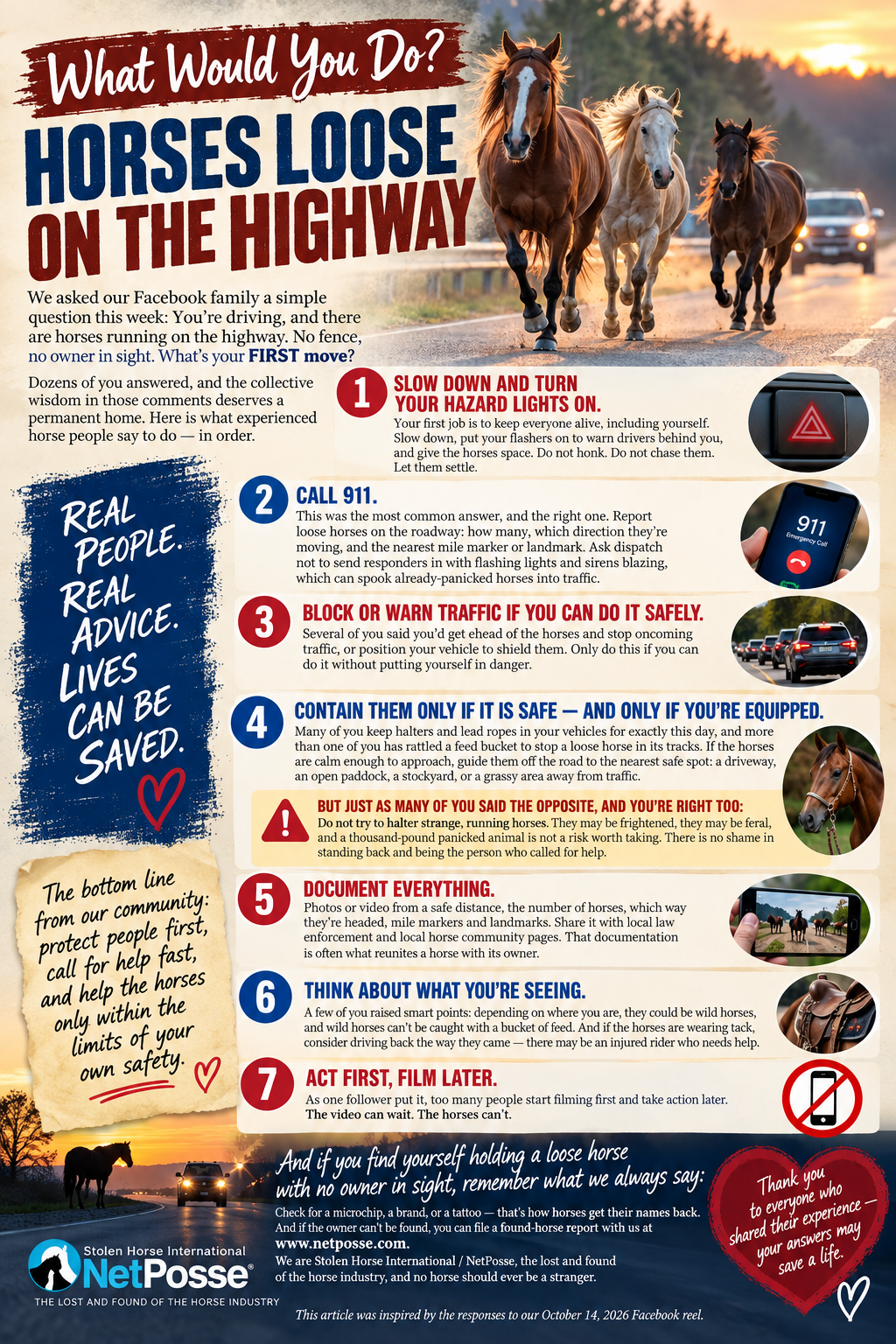
You’re driving down the highway when suddenly you see them.
Horses.
They’re loose, frightened, and running along—or directly into—the roadway. There’s no trailer pulled over nearby. No owner chasing behind them. No obvious broken fence.
Traffic is coming.
What is your first move?
We recently asked our Facebook family that question, and dozens of people responded. Some had handled loose-horse emergencies themselves. Others shared the precautions they would take based on years of experience around horses.
Their answers were thoughtful, practical, and sometimes remarkably resourceful. More importantly, the collective wisdom in those comments could someday help save lives.
So, with thanks to everyone who joined the conversation, we’re giving that advice a permanent home.
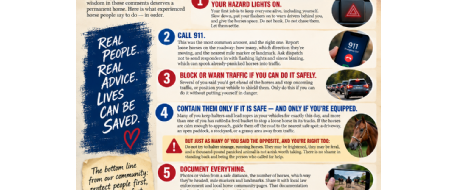
1. Slow Down. Turn On Your Hazard Lights.
Before you try to help the horses, protect human life—including your own.
Reduce your speed immediately and turn on your hazard lights to warn the drivers behind you. Give the horses as much room as possible.
Remember: these animals may already be terrified. A frightened horse can change direction without warning.
Do not honk. Do not rev your engine. Do not chase them with your vehicle.
Your goal is to reduce the chaos, not add to it.
2. Call 911
This was one of the most common answers from our Facebook community—and for good reason.
Loose horses on an active roadway are an emergency.
Tell the dispatcher how many horses you see, the road or highway you are traveling on, the nearest mile marker, intersection, exit, or recognizable landmark, and which direction the horses are moving.
One follower offered another excellent suggestion: tell dispatch that the horses appear frightened and, if circumstances permit, ask responding personnel to avoid approaching them with unnecessary sirens or flashing lights that could cause them to panic further.
The faster authorities know what is happening and where, the faster traffic control and appropriate assistance can begin.
3. Warn Other Drivers—But Don't Become Another Emergency
Several followers said they would try to get ahead of the horses and warn or stop oncoming traffic. Others suggested carefully positioning a vehicle to help shield the horses from approaching cars.
That may be helpful only when it can be done safely and legally.
Never step into moving traffic, stop your vehicle where approaching motorists cannot see you, or place yourself in a position where you could be struck.
There is already an emergency unfolding.
Don't accidentally create a second one.
4. Should You Try to Catch Them? It Depends.
This question generated some of the most important discussion.
Many experienced horse people told us they keep halters and lead ropes in their vehicles for exactly this kind of situation. Others have discovered that the familiar rattle of grain in a feed bucket can convince a loose horse to stop running and investigate.
One follower even described improvising a halter from a scarf and belt, moving a horse into the nearest fenced yard, and calling 911 from a smartwatch while handling the situation.
Resourceful? Absolutely.
But there is another side to this advice that is equally important:
You do not know every horse.
A strange horse running down a highway may be terrified, injured, poorly handled, or unaccustomed to people. In some areas, the animals could even be free-roaming or wild horses.
A panicked animal weighing 1,000 pounds or more can seriously injure someone in seconds.
If you are experienced with horses, have appropriate equipment, the animals have settled enough to approach safely, and you can move them away from traffic without endangering yourself or anyone else, you may be able to guide them into a nearby safe area such as a driveway, fenced paddock, stockyard, or grassy area well away from traffic.
But knowing when not to approach is every bit as important as knowing how to handle a horse.
There is no shame in standing back, keeping track of the horses from a safe location, warning others, and being the person who called for professional help.
That person may have just saved a life.
5. Document What You See
Once immediate safety needs have been addressed, documentation can become extremely valuable.
If you can safely do so, take photographs or video. Note the number and descriptions of the horses, their direction of travel, the location, nearby landmarks, mile markers, and anything unusual you notice.
Then provide that information to law enforcement and, when appropriate, local horse-community networks.
Why does this matter?
Because after the immediate danger is over, another problem begins:
Who owns these horses?
A clear photograph shared in the right place may be recognized by an owner, veterinarian, farrier, trainer, boarding stable, neighbor, or someone who saw the horses earlier.
The picture you take today could become the clue that gets them home tomorrow.
6. Look Beyond the Obvious
Several members of our community raised points that are easy to overlook in the urgency of the moment.
First, know your surroundings. In some parts of the country, horses encountered near roadways may be free-roaming or wild horses. The appropriate response may be very different from dealing with someone's escaped pasture horse.
Second, look at the horse.
Is it wearing a halter?
A saddle?
A bridle?
Are the reins hanging loose?
If a horse is running down a road wearing riding tack and there is no rider anywhere in sight, the emergency may involve more than the horse.
There could be an injured rider somewhere behind it.
Tell emergency dispatchers what you see so responders know there may be a person who also needs help.
7. Act First. Film Later.
One comment from our discussion deserves special attention.
In an age when nearly everyone carries a camera in their pocket, our first instinct can be to record what is happening.
But when horses are running through traffic, the priority is safety—not social media.
Call for help first.
Warn others if you can safely do so.
Help prevent an accident.
There will be time for photographs and video once the immediate danger has been addressed.
The horses cannot wait for the perfect shot.
The Bottom Line: Protect People, Call for Help, Then Help the Horses
If there was one message that came through repeatedly in the responses from our community, it was this:
Protect people first. Call for help quickly. Help the horses only within the limits of your experience and personal safety.
Good intentions are important, but good judgment matters just as much.
And once those horses are safely contained, the next mission begins—finding out where they belong.
A Safe Horse Isn't Necessarily a Horse Going Home
Imagine the horses have been caught. The highway is clear. The immediate danger has passed.
But nobody recognizes them.
No owner has appeared.
Now what?
Look for identification. A microchip, brand, tattoo, or other identifying information may provide the crucial link between an unknown horse and the family desperately searching for it.
At Stolen Horse International–NetPosse, we often say that identification is how horses get their names back.
If you've found a horse and the owner cannot be located, file a free found-horse report with us at NetPosse.com.
Documenting the horse and getting accurate information in front of the right people can help turn an unidentified animal into someone's long-awaited reunion.
We are Stolen Horse International–NetPosse, the lost and found of the horse industry.
No horse should ever be a stranger.
This Article Started With You
This article was inspired by the responses to our October 14, 2026 Facebook reel, where we asked our followers what they would do if they encountered horses loose on a highway.
To everyone who commented, shared an experience, offered advice, or told us what worked when you faced a similar situation: thank you.
Social media conversations can disappear down a newsfeed in a matter of days.
Good information shouldn't.
We're preserving your collective wisdom here because someday, somewhere, a driver may round a curve and suddenly see horses running toward traffic.
And because someone took the time to share what they knew, that person may know exactly what to do.
Your experience may save a horse.
It may also save a human life.
Stolen Horse International provides news and other resources for free on this website. As a charitable organization we survive on the kindness of people like you. Please consider donating to help fund the organization or purchasing a NetPosse ID for your horse, dog or cat to help protect your beloved animals!
Debi Metcalfe
Please login to post a comment.
Related Articles




Comments