


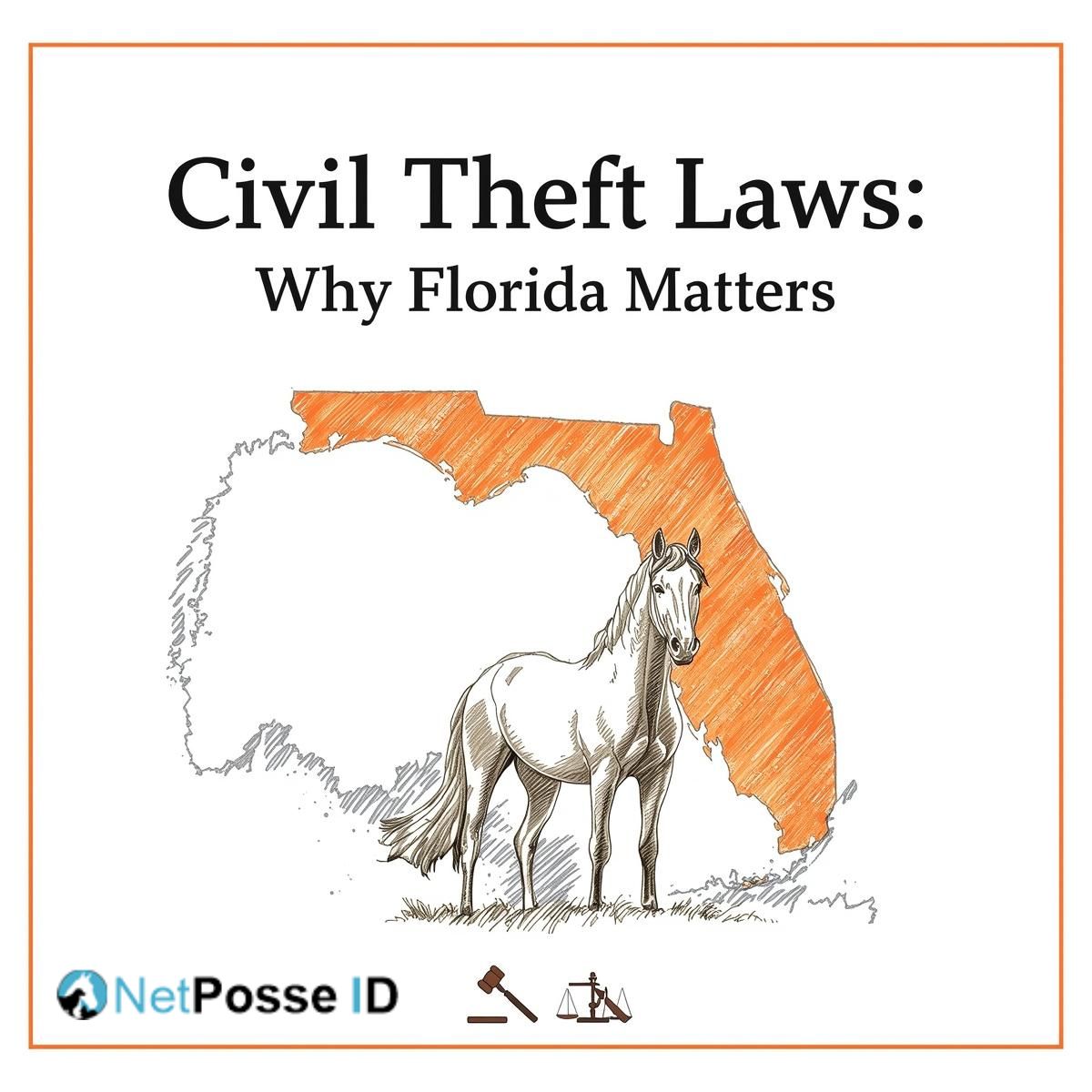
Civil Theft Laws in the United States: Why Florida Matters
While theft is typically addressed through criminal law, Florida is one of the few states that provides a broad civil cause of action for theft. This distinction is critical in equine and livestock cases, where possession is often disputed and criminal charges are difficult to pursue.
Florida’s Civil Theft Statute
Florida law allows a private individual to pursue a civil lawsuit for theft separate from any criminal prosecution.
Florida Statute § 772.11 — Civil Remedy for Theft or Exploitation
Florida Statute § 772.11 provides that:
“Any person who proves by clear and convincing evidence that he or she has been injured by reason of any violation of §§ 812.012–812.037 has a cause of action for threefold the actual damages sustained and, in any such action, is entitled to minimum damages in the amount of $200 and reasonable attorney’s fees and court costs.”
This statute allows a claimant to:
- File a civil theft lawsuit
- Seek treble (triple) damages
- Recover attorney’s fees and court costs
- Proceed even if no criminal charges are filed
The statute also requires a pre-suit written demand giving the accused party 30 days to pay damages before a lawsuit can be filed.
Underlying Criminal Theft Definition
Civil theft claims in Florida are based on conduct defined under the state’s criminal theft laws.
Florida Statute § 812.014 — Theft states that a person commits theft if they:
“Knowingly obtain or use, or endeavor to obtain or to use, the property of another with intent to, either temporarily or permanently, deprive the other person of a right to the property or a benefit from the property.”
This definition forms the legal foundation for civil theft claims under § 772.11.
How Florida Differs From Other States
Florida is widely recognized as nearly unique in having a broad civil theft statute that applies to theft of property in general—not just retail theft or shoplifting.
Most other states:
- Require theft to be handled exclusively through criminal courts
- Limit civil recovery statutes to retail theft or shoplifting
- Do not provide a general civil cause of action for theft of livestock or personal property
Some states do allow limited civil recovery in specific contexts (such as retail theft), but these statutes are narrow and do not apply broadly to property disputes involving horses or livestock.
Does the Civil Theft Law Apply to Livestock?
The Civil Theft Law Applies to Violations of the Theft Statutes
Florida’s civil statute, § 772.11 — Civil Remedy for Theft or Exploitation, creates a civil cause of action whenever someone is harmed by a violation of the state’s criminal theft statutes. It does not list specific types of property itself, but it applies to any violation of the criminal theft statutes it references.
“Any person who proves by clear and convincing evidence that he or she has been injured … by reason of any violation of ss. 812.012–812.037 … has a cause of action…”
That means the civil claim depends on whether the underlying conduct may constitute a crime under Florida’s theft statutes.
Criminal Theft Laws in Florida Include Livestock
Under Florida’s criminal theft statutes — Chapter 812 — certain types of property are explicitly included, and livestock (including horses) are among them when the value meets the thresholds for grand theft. For example:
- Florida law defines grand theft to include taking the property of another valued above certain amounts and includes:
- “Any commercially farmed animal including any animal of the equine, bovine, or swine class, or other grazing animal” as property that qualifies for grand theft if its value meets the statutory thresholds.
This means horses, cattle, and similar livestock are treated as property for purposes of the criminal theft statutes in Chapter 812.
So the Civil Statute Extends to Livestock Theft
Because:
- § 772.11 gives a civil cause of action based on violations of the criminal theft statutes, and
- Florida’s criminal theft statutes include livestock like horses as theft property when taken unlawfully, — a civil theft claim under § 772.11 may be based on livestock theft, including horses.
In plain terms: if someone’s conduct would qualify as criminal theft of a horse or other livestock under Chapters 812 (and the harm can be proven), that same conduct can form the basis for a civil action under § 772.11 seeking damages, attorney’s fees, and treble damages.
Why This Matters in Equine Cases
In equine cases, civil theft statutes can be used in ways that:
- Shift disputes out of criminal court
- Increase the financial burden on victims
- Create leverage through costly litigation
- Allow possession of a horse to change hands without a judge ever hearing the case
Because civil theft claims require clear and convincing evidence and significant financial resources, many victims are unable to pursue them—resulting in cases that quietly resolve without judicial review.
This legal landscape is one of the reasons NetPosse closely monitors and documents civil cases involving horses, particularly when civil statutes are used in ways that obscure ownership, possession, or horse welfare.
Disclaimer: NetPosse does not provide legal advice and does not replace licensed legal counsel. This article may include research assisted by artificial intelligence (AI), which could be inaccurate or incomplete. Information is provided for educational purposes only; please verify independently and consult qualified professionals for legal or equine matters.
Stolen Horse International provides news and other resources for free on this website. As a charitable organization we survive on the kindness of people like you. Please consider donating to help fund the organization or purchasing a NetPosse ID for your horse, dog or cat to help protect your beloved animals!
Debi Metcalfe
Please login to post a comment.
Related Articles








Comments