
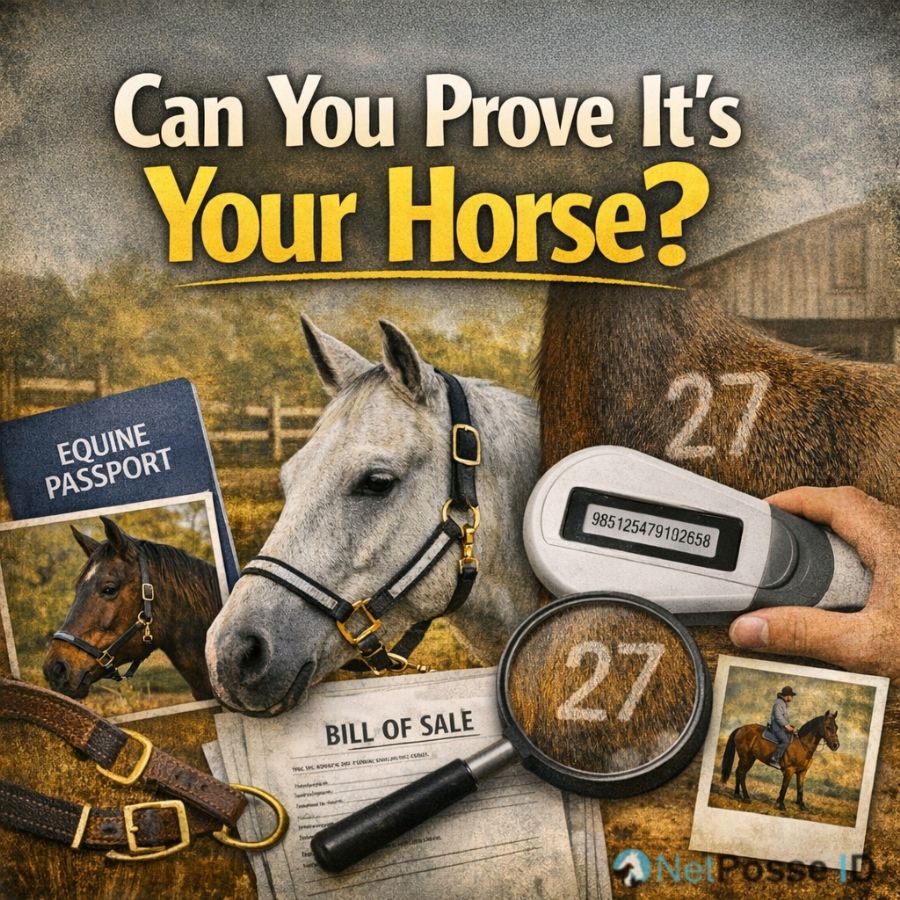
Can You Prove It’s Your Horse?
It’s every horse owner’s worst nightmare.
You go out to the pasture and… your horse isn’t there.
A barn manager calls asking if you stopped by yesterday—because your trailer is gone.
You pull over for lunch on the way to a show, only to return and find your trailer, tack, and horses missing.
You lease a horse to someone you trust, and months—or years—later you discover the horse has been sold, with no paperwork to be found. Worse yet, it was sent through an auction.
When the unthinkable happens, there’s one urgent question that matters above all others:
What do you do—and can you prove ownership?
“That’s My Horse” Isn’t Proof
Walking up to a horse and telling law enforcement, “That’s my horse,” doesn’t work. Officers cannot—and will not—accept verbal claims as proof of ownership.
Old photographs don’t help much either. A few distant pictures of a child sitting on a horse years ago won’t establish ownership. To someone outside your family—and especially someone unfamiliar with horses—it often looks like just another child on yet another bay horse. One brown horse with a black mane and tail looks much like the next unless specific, identifiable details are documented.
The goal isn’t just recognition.
The goal is getting your horse home.
What About Coggins Papers?
Yes, Coggins paperwork is important. It’s required for interstate travel and crossings, and it’s a federally regulated document.
But here’s the hard truth: Coggins papers alone are rarely enough to prove ownership.
Despite penalties for forgery or misuse, people intent on stealing animals are unlikely to be deterred by paperwork rules. A Coggins test identifies a horse for disease control purposes—it does not reliably establish legal ownership.
The Reality of Property Crimes
Horse theft, trailer theft, and tack theft are legally classified as property crimes. Historically, only about 40% of property crimes are solved—and that’s only when the property is properly documented, identified, and traceable.
That responsibility falls largely on you, the owner.
Law enforcement will assist, but agencies must prioritize crimes against people over crimes against property. This isn’t a lack of care—it’s a matter of limited resources and public safety realities.
What Proper Documentation Really Means
To recover stolen or missing equine property, three critical elements must be in place:
- Clear Documentation
Records must describe the horse in specific detail:- Breed, color, sex, age, height
- Unique markings, scars, or brands
- Owner name and contact information
- Positive Identification
Your horse should be unmistakably identifiable:- Registered name and barn name
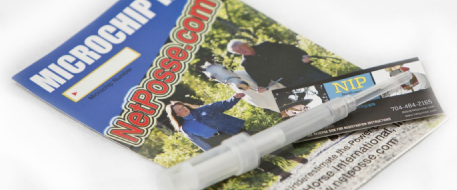
- Microchip number
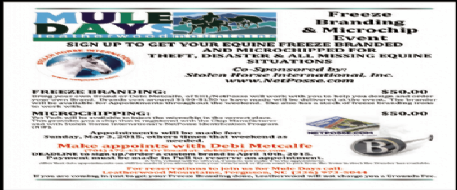
- Freeze brand or other permanent marking
- Detailed photographs: front, both sides, rear, and close‑ups of scars, whorls, and markings
- Traceability
Identification only works if it’s registered:- Microchips and brands must be recorded with a third party
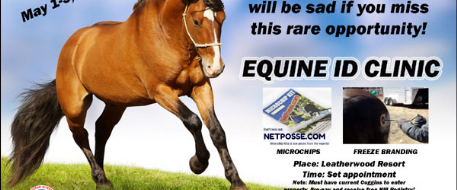
- Databases such as NetPosse provide independent verification and tracing
Without these elements, proving ownership becomes extremely difficult—sometimes impossible.
Why Preparation Matters
In most cases, you will be the primary searcher for your own property. Public reports, networking, social media, auction monitoring, and leads all take time and coordination.
NetPosse.com and StolenHorseInternational.com provide a documented, proven protocol for reporting and broadcasting missing equine property when it matters most. They do not dispatch search parties or volunteers, but they do offer:
- An international posting and alert platform
- Information-sharing tools
- Educational resources
- Identification and documentation guidance
These tools exist to support owners—but they work best when preparation happens before a loss.
Do the Work Now—Not Later
Please do your homework now, before an emergency forces you to scramble. Proper identification and documentation are far less expensive—and far less heartbreaking—than trying to recover a horse after the fact.
Think of it as insurance.
An ounce of prevention truly is worth more than a pound of cure. We would much rather you never need these services at all. Life is too short for this kind of heartbreak.
Stolen Horse International provides news and other resources for free on this website. As a charitable organization we survive on the kindness of people like you. Please consider donating to help fund the organization or purchasing a NetPosse ID for your horse, dog or cat to help protect your beloved animals!
Debi Metcalfe
Please login to post a comment.
Related Articles



Comments