


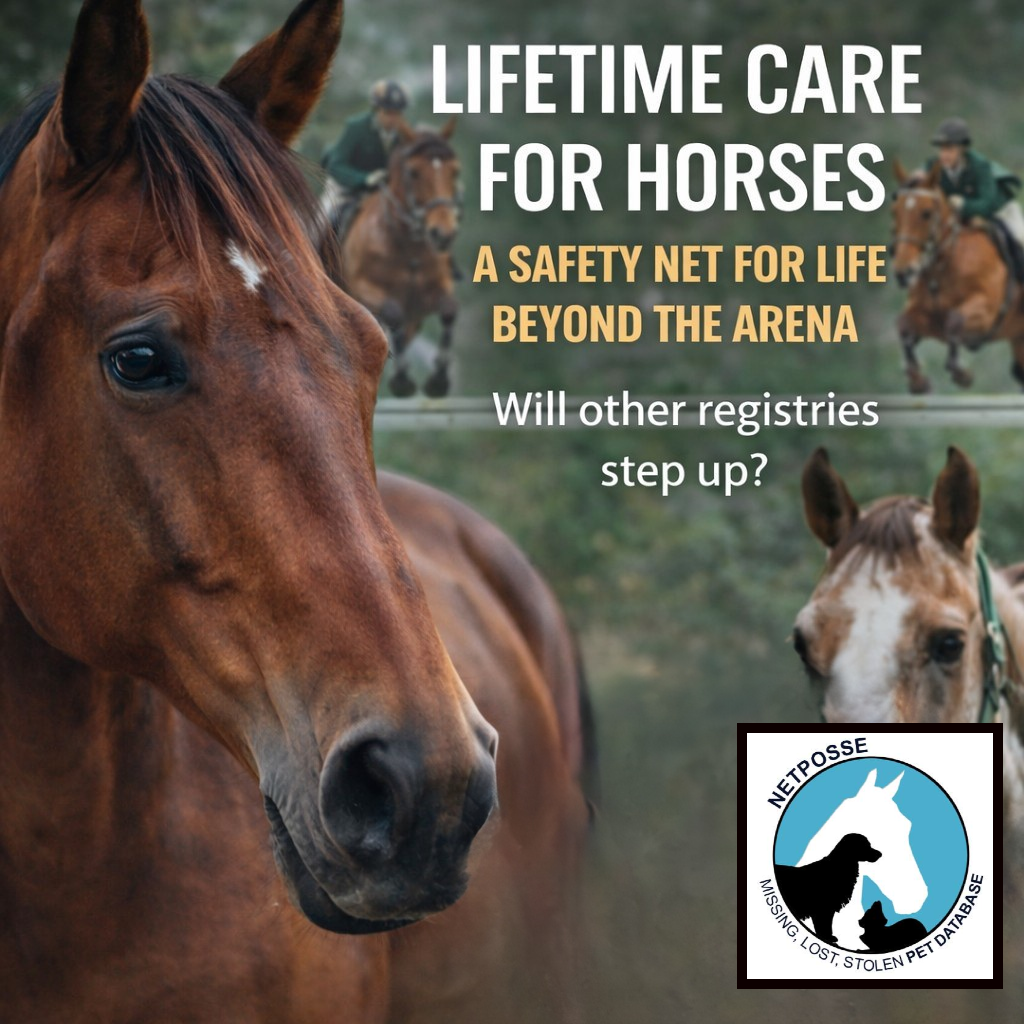
USEF Lifetime Care Feature – A Call For Industry-wide Action
At Stolen Horse International, also known as NetPosse, we spend every day dealing with the realities of what happens when horses fall through the cracks — when ownership changes, records are lost, or no one can be reached when a horse is found abandoned, neglected, or at risk. That is why we want to recognize and highlight an important new program launched by US Equestrian (USEF): the Lifetime Care feature.
This program represents a meaningful step toward accountability and lifelong responsibility for horses, and it is exactly the kind of forward-thinking initiative the equine industry needs more of.
What Is the USEF Lifetime Care Feature?
USEF’s Lifetime Care feature allows individuals to voluntarily add themselves as Lifetime Care Contacts on a horse’s official USEF record. These contacts indicate that they are willing to be notified if the horse is ever in need of assistance, placement, or support later in life.
Lifetime Care Contacts can include breeders, past owners, trainers, riders, or anyone with a long-term connection to the horse. Multiple contacts can be listed for a single horse, creating a broader safety net if the horse’s situation changes.
Importantly, this program is free, optional, and does not require the contact to be the current owner. It is simply a way to say: “If this horse ever needs help, I want to know.”
How Microchipping and Lifetime Care Work Together
In addition to the Lifetime Care feature, USEF also requires horses competing in national-level competitions to be microchipped. A microchip provides a permanent, unique identifier that stays with the horse for life — regardless of name changes, ownership transfers, or location. When a horse is scanned, the microchip number can be used to quickly locate that horse’s official USEF record.
When these two programs are used together, they create a powerful system for lifetime identification and welfare. A microchip helps confirm who the horse is, while the Lifetime Care feature helps identify who cares. If a horse is found missing, abandoned, or in a questionable situation, the microchip can lead to the record — and the record can lead to people willing to help.
From our perspective at Stolen Horse International, this combination addresses one of the most persistent failures in equine welfare and theft recovery: horses that cannot be reliably identified, and records that lead nowhere. Too often, we see horses recovered or located only to hit a dead end because there is no permanent identifier or no meaningful contact attached to that identity.
USEF’s model acknowledges a critical truth: identification without accountability is not enough — and accountability without identification is impossible. Together, microchipping and Lifetime Care close that gap.
Why This Matters in Missing and Stolen Horse Cases
In theft, fraud, abandonment, and illegal sales cases, microchips are often the single most reliable way to confirm a horse’s identity. When that identity is tied to an active database — and further supported by Lifetime Care Contacts — recovery efforts no longer rely solely on outdated paperwork, changing names, or social media guesswork.
This is the difference between hoping someone comes forward and knowing who to call.
A Direct Challenge to Registries Without Microchip Requirements
At Stolen Horse International, we believe it is time to say this plainly: registries and associations that do not require permanent identification are leaving horses vulnerable.
Microchipping is not new technology. It is widely available, affordable, and already proven effective in recovery and welfare cases. Registries that continue to rely solely on paper records, tattoos, brands, or owner-reported updates are maintaining systems that fail horses when they need protection the most.
We challenge breed registries, sport organizations, and recording bodies that have not yet implemented mandatory microchipping — or that do not link identification to meaningful welfare contacts — to reconsider their role in lifelong equine responsibility.
A Model Worth Replicating
USEF’s combined use of mandatory microchips and voluntary Lifetime Care Contacts offers a blueprint the rest of the industry can learn from. It is not about control or enforcement — it is about foresight.
Horses do not disappear because people stop caring. They disappear because systems fail to keep caring visible.
Why This Matters to Stolen Horse International
One of the most common obstacles we encounter when helping locate missing, stolen, or displaced horses is the lack of reliable, current contact information. Horses change hands, paperwork disappears, and well-meaning people who once cared deeply about a horse may never know that animal ended up in trouble.
Programs like USEF’s Lifetime Care feature help bridge that gap.
When a horse is found and identified through the USEF system, the presence of Lifetime Care Contacts can mean:
- Someone answers the phone
- Someone remembers the horse
- Someone is willing to step in
That single connection can be the difference between a horse finding help — or being lost to the system.
This Is Not Enforcement — It’s Connection
It is important to understand what this program is and what it is not.
USEF does not enforce outcomes, assign responsibility, or mandate action. The Lifetime Care feature simply facilitates connection. Communication happens directly between the person who finds the horse and the Lifetime Care Contacts listed. Decisions are made by the individuals involved.
From our perspective, this approach respects personal boundaries while still prioritizing the horse.
A Challenge to Other Registries and Associations
We applaud USEF for taking this step — and we believe it should not stop there.
Stolen Horse International challenges other registries, breed associations, sport organizations, and equine databases to adopt similar lifetime care tools. Every registry maintains records. Every registry can build in a mechanism that acknowledges a simple truth: responsibility for a horse should not end when ownership changes.
Imagine the impact if every registered horse had:
- A permanent welfare contact option
- A way to reconnect with people who once cared for them
- A documented safety net for the future
Horses Deserve Lifelong Consideration
At Stolen Horse International, we believe that equine welfare is not a moment — it is a lifetime commitment. USEF’s Lifetime Care feature moves the industry closer to that ideal, and we hope it inspires broader change.
We encourage USEF members to participate in this program and urge other organizations to consider how similar systems could protect horses long after the spotlight fades.
Because every horse’s story matters — and every horse deserves someone willing to be there when it counts.
To learn more about USEF'S Lifetime Care feature, visit the US Equestrian website.
Research Disclaimer: This article was researched and prepared using publicly available information released by US Equestrian regarding its Lifetime Care feature and microchip requirements. All interpretations, opinions, and advocacy positions expressed here reflect the mission, experience, and perspective of Stolen Horse International, and are not statements made by or on behalf of US Equestrian. As with all educational and advocacy content produced by Stolen Horse International, this article is intended to promote awareness, discussion, and improved equine welfare practices across the industry.
Stolen Horse International provides news and other resources for free on this website. As a charitable organization we survive on the kindness of people like you. Please consider donating to help fund the organization or purchasing a NetPosse ID for your horse, dog or cat to help protect your beloved animals!
Debi Metcalfe
Please login to post a comment.
Related Articles


Comments